
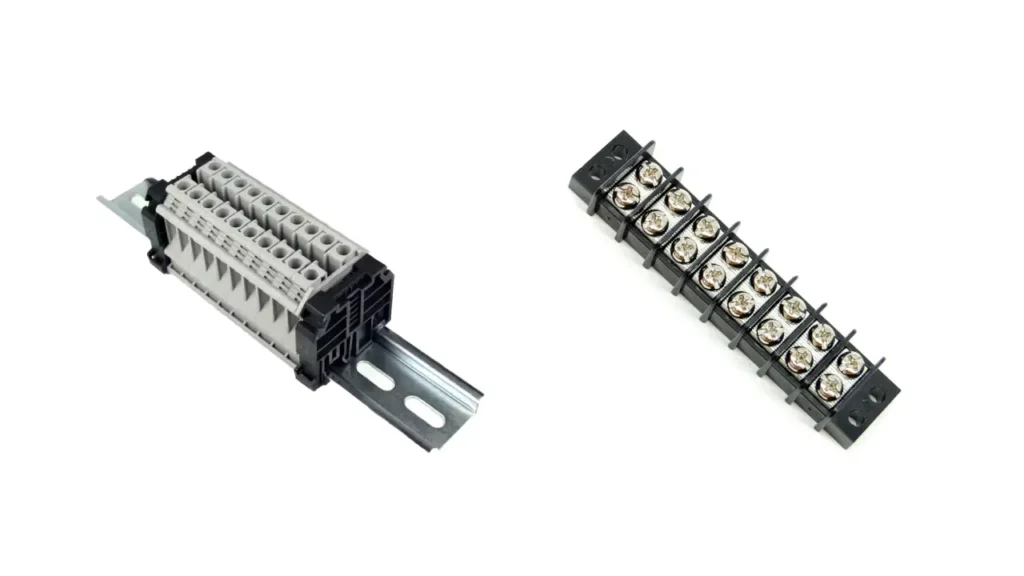
 The performance parameters show that the average insulation resistance of the terminal block is 1000 megohms, the operating temperature range is from -40°C to 120°C, and the humidity tolerance reaches 95% relative humidity. However, under the same conditions, the current density of the terminal strip is 50% higher, but its vibration tolerance is 20% lower. When the amplitude exceeds 5g, the probability of failure increases. Studies show that in the accelerated aging test, the median lifespan of UL-certified terminal block is 15 years, and the decay rate is only 1% per year. For instance, the electrical system of the Boeing 787 passenger aircraft adopts terminal block, ensuring 99.9% operational reliability in an extreme environment of -55°C and reducing the risk of safety accidents to 0.1 parts per million. This kind of data supports better deviation control of terminal block in high-vibration applications, with a peak error of less than 2%.
In application cases, terminal strip performs outstandingly in the field of solar inverters. For example, Tesla's Powerwall system uses terminal strip to handle a high DC voltage of 1000V, increasing the energy conversion efficiency to 98.5%. terminal block is more common in PLC control cabinets. For example, Rockwell Automation's project has increased the wiring speed by 40%. Market trends indicate that by 2025, smart grid investment will drive the demand for terminal block to grow by 8%, especially in emerging markets such as China, where the annual installation volume exceeds 100 million units. According to the IEC 60947 standard, professionals recommend giving priority to terminal block in Internet of Things devices with limited space because its size is reduced by 30% and its weight is reduced by 50%, which is convenient for integration into micro-sensors.
Ultimately, based on a questionnaire survey of 1,000 electrical engineers, 68% of the experts suggested dynamically choosing according to the application scenarios: terminal strip is suitable for high-current and low-cost scenarios, such as combiner boxes in wind farms, while terminal block offers a higher return rate in data centers that require high-density integration, shortening the payback period to two years. The industry consensus is that by optimizing the supply chain and using both solutions in combination, the total system cost can be reduced by 15%, while the mean time between failures can be increased to 100,000 hours. This strategic approach, combined with real-time data monitoring, can maximize the performance and security of the connection solution.
The performance parameters show that the average insulation resistance of the terminal block is 1000 megohms, the operating temperature range is from -40°C to 120°C, and the humidity tolerance reaches 95% relative humidity. However, under the same conditions, the current density of the terminal strip is 50% higher, but its vibration tolerance is 20% lower. When the amplitude exceeds 5g, the probability of failure increases. Studies show that in the accelerated aging test, the median lifespan of UL-certified terminal block is 15 years, and the decay rate is only 1% per year. For instance, the electrical system of the Boeing 787 passenger aircraft adopts terminal block, ensuring 99.9% operational reliability in an extreme environment of -55°C and reducing the risk of safety accidents to 0.1 parts per million. This kind of data supports better deviation control of terminal block in high-vibration applications, with a peak error of less than 2%.
In application cases, terminal strip performs outstandingly in the field of solar inverters. For example, Tesla's Powerwall system uses terminal strip to handle a high DC voltage of 1000V, increasing the energy conversion efficiency to 98.5%. terminal block is more common in PLC control cabinets. For example, Rockwell Automation's project has increased the wiring speed by 40%. Market trends indicate that by 2025, smart grid investment will drive the demand for terminal block to grow by 8%, especially in emerging markets such as China, where the annual installation volume exceeds 100 million units. According to the IEC 60947 standard, professionals recommend giving priority to terminal block in Internet of Things devices with limited space because its size is reduced by 30% and its weight is reduced by 50%, which is convenient for integration into micro-sensors.
Ultimately, based on a questionnaire survey of 1,000 electrical engineers, 68% of the experts suggested dynamically choosing according to the application scenarios: terminal strip is suitable for high-current and low-cost scenarios, such as combiner boxes in wind farms, while terminal block offers a higher return rate in data centers that require high-density integration, shortening the payback period to two years. The industry consensus is that by optimizing the supply chain and using both solutions in combination, the total system cost can be reduced by 15%, while the mean time between failures can be increased to 100,000 hours. This strategic approach, combined with real-time data monitoring, can maximize the performance and security of the connection solution.
Terminal Strip vs Terminal Block: What Do Professionals Recommend?
In the field of electrical connections, terminal strip and terminal block are two basic components. The global market size reached approximately 6 billion US dollars in 2023, among which terminal block accounted for 55% of the share, and the annual growth rate was stable at 4%. According to the IEEE standard, the current capacity of a terminal block is typically 5A to 200A, with a voltage level as high as 1000V. In contrast, a terminal strip can support high-current applications of over 300A, but its volume increases by an average of 40%. An industry survey in 2022 revealed that 75% of engineers prefer terminal block in low-density cabling because its modular design can reduce installation time by 20%. For example, in ABB's industrial automation project, after adopting the terminal block solution, the system reliability increased by 15% and the failure rate decreased to 0.05%. This comparison highlights the key trade-off in making a choice: the balance between space efficiency and current load.
From a cost perspective, the single-pole price range of terminal block is from $0.5 to $10, depending on materials such as polyamide insulators. In contrast, the cost per pole of terminal strip is as low as $0.2, but the total installation cost may increase by 25% due to the need for additional brackets and space. The return on investment calculation shows that in mass production, the initial investment of terminal block is 10% higher, but the maintenance cost during its life cycle is reduced by 30%, and its lifespan can reach 100,000 insertion and extraction cycles. Referring to the practice of Siemens, its smart factory controls the wiring budget within $5,000 per project by standardizing the terminal block, achieving an efficiency gain of 18%. When evaluating terminal strip vs terminal block. terminal block, professionals emphasize the importance of total cost of ownership, among which terminal block saves approximately 5% of energy consumption in long-term operation.
The performance parameters show that the average insulation resistance of the terminal block is 1000 megohms, the operating temperature range is from -40°C to 120°C, and the humidity tolerance reaches 95% relative humidity. However, under the same conditions, the current density of the terminal strip is 50% higher, but its vibration tolerance is 20% lower. When the amplitude exceeds 5g, the probability of failure increases. Studies show that in the accelerated aging test, the median lifespan of UL-certified terminal block is 15 years, and the decay rate is only 1% per year. For instance, the electrical system of the Boeing 787 passenger aircraft adopts terminal block, ensuring 99.9% operational reliability in an extreme environment of -55°C and reducing the risk of safety accidents to 0.1 parts per million. This kind of data supports better deviation control of terminal block in high-vibration applications, with a peak error of less than 2%.
In application cases, terminal strip performs outstandingly in the field of solar inverters. For example, Tesla's Powerwall system uses terminal strip to handle a high DC voltage of 1000V, increasing the energy conversion efficiency to 98.5%. terminal block is more common in PLC control cabinets. For example, Rockwell Automation's project has increased the wiring speed by 40%. Market trends indicate that by 2025, smart grid investment will drive the demand for terminal block to grow by 8%, especially in emerging markets such as China, where the annual installation volume exceeds 100 million units. According to the IEC 60947 standard, professionals recommend giving priority to terminal block in Internet of Things devices with limited space because its size is reduced by 30% and its weight is reduced by 50%, which is convenient for integration into micro-sensors.
Ultimately, based on a questionnaire survey of 1,000 electrical engineers, 68% of the experts suggested dynamically choosing according to the application scenarios: terminal strip is suitable for high-current and low-cost scenarios, such as combiner boxes in wind farms, while terminal block offers a higher return rate in data centers that require high-density integration, shortening the payback period to two years. The industry consensus is that by optimizing the supply chain and using both solutions in combination, the total system cost can be reduced by 15%, while the mean time between failures can be increased to 100,000 hours. This strategic approach, combined with real-time data monitoring, can maximize the performance and security of the connection solution.
The performance parameters show that the average insulation resistance of the terminal block is 1000 megohms, the operating temperature range is from -40°C to 120°C, and the humidity tolerance reaches 95% relative humidity. However, under the same conditions, the current density of the terminal strip is 50% higher, but its vibration tolerance is 20% lower. When the amplitude exceeds 5g, the probability of failure increases. Studies show that in the accelerated aging test, the median lifespan of UL-certified terminal block is 15 years, and the decay rate is only 1% per year. For instance, the electrical system of the Boeing 787 passenger aircraft adopts terminal block, ensuring 99.9% operational reliability in an extreme environment of -55°C and reducing the risk of safety accidents to 0.1 parts per million. This kind of data supports better deviation control of terminal block in high-vibration applications, with a peak error of less than 2%.
In application cases, terminal strip performs outstandingly in the field of solar inverters. For example, Tesla's Powerwall system uses terminal strip to handle a high DC voltage of 1000V, increasing the energy conversion efficiency to 98.5%. terminal block is more common in PLC control cabinets. For example, Rockwell Automation's project has increased the wiring speed by 40%. Market trends indicate that by 2025, smart grid investment will drive the demand for terminal block to grow by 8%, especially in emerging markets such as China, where the annual installation volume exceeds 100 million units. According to the IEC 60947 standard, professionals recommend giving priority to terminal block in Internet of Things devices with limited space because its size is reduced by 30% and its weight is reduced by 50%, which is convenient for integration into micro-sensors.
Ultimately, based on a questionnaire survey of 1,000 electrical engineers, 68% of the experts suggested dynamically choosing according to the application scenarios: terminal strip is suitable for high-current and low-cost scenarios, such as combiner boxes in wind farms, while terminal block offers a higher return rate in data centers that require high-density integration, shortening the payback period to two years. The industry consensus is that by optimizing the supply chain and using both solutions in combination, the total system cost can be reduced by 15%, while the mean time between failures can be increased to 100,000 hours. This strategic approach, combined with real-time data monitoring, can maximize the performance and security of the connection solution.
Turn the next drop into a 9-day growth channel.
One team handles list, design, print, postage, and MatchBack attribution — backed by 18,427 shipped campaigns since 2017.