
A scent experience venue is a research tool, not a showroom. Used well, a museum or an olfactive library compresses months of fragrance education into a day: it widens your reference points, exposes the gaps in your brief, and shows whether a supplier's palette is deep enough for the category you are entering. What it cannot do is prove that anyone can manufacture to a specification - that still has to be settled with samples, stability data and a batch record.
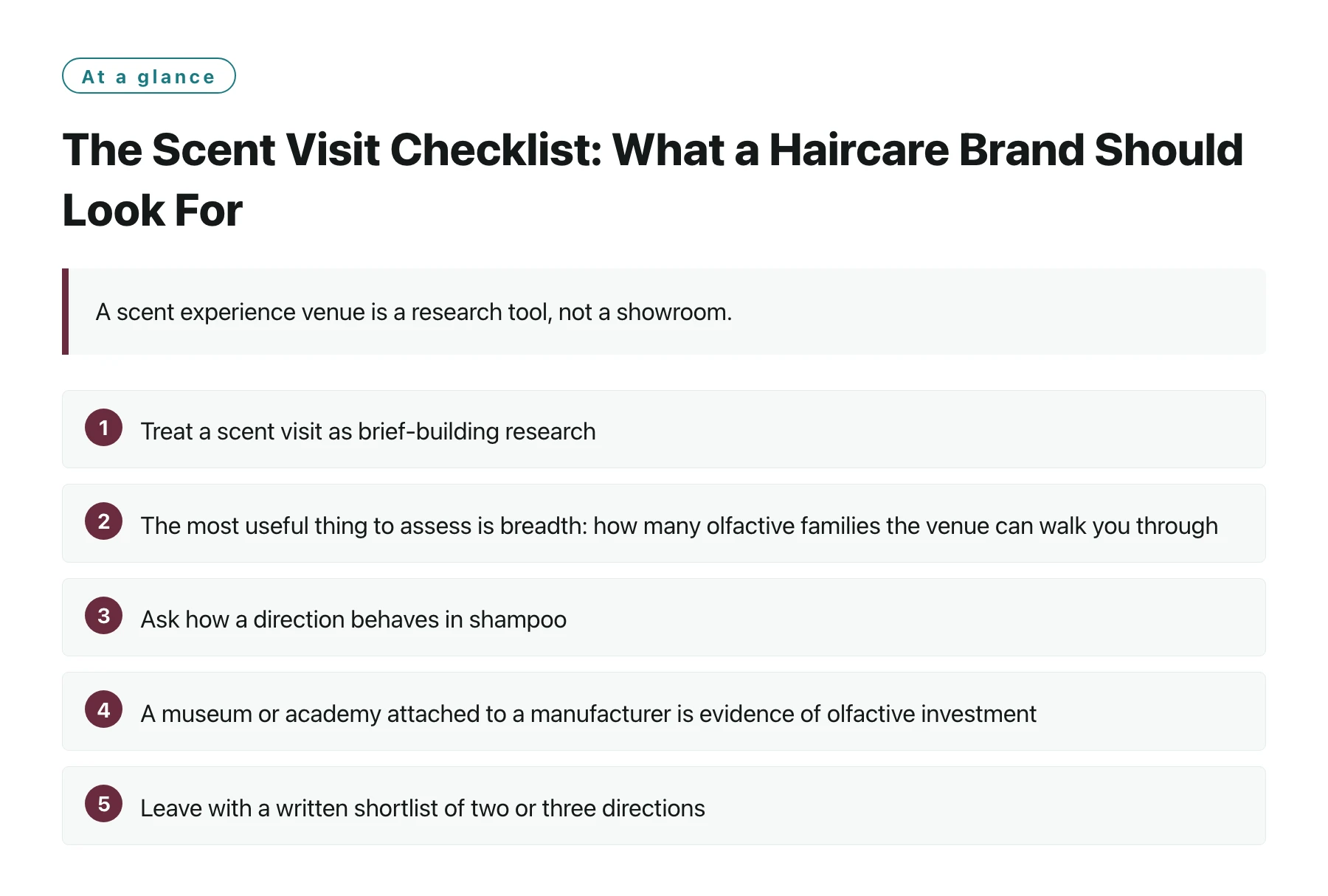
Key takeawaysTreat a scent visit as brief-building research, not as entertainment and not as a sales event. · The most useful thing to assess is breadth: how many olfactive families the venue can walk you through, and whether any of them survive in a hair-care base. · Ask how a direction behaves in shampoo, conditioner and leave-in mist, because base chemistry changes what a concentrate smells like on hair. · A museum or academy attached to a manufacturer is evidence of olfactive investment, not evidence of production capability. · Leave with a written shortlist of two or three directions, each tied to reference materials, so sampling starts from a shared vocabulary.
Haircare brands usually arrive at scent the long way round. A shampoo or conditioner base is chemically hostile to fragrance - surfactants, pH and a high water content change how a concentrate reads - so a direction that smelled clean on a blotter can turn flat or sharp in the bottle. Buyers who have not built a wide reference library often end up describing what they want in adjectives that no perfumer can work with.
A scent experience - a museum, an olfactive library, a perfumery floor with classrooms attached - is the fastest way to fix that. It gives a brand team a shared vocabulary, and it gives the buyer a way to judge whether a supplier's palette is broad enough for the category they are entering. What follows is what to assess on the visit, what to ask while you are there, and how to turn the day into a brief that survives sampling.
Why the visit earns a place in due diligence
Most supplier evaluation happens on paper: certificates, a scope statement, a price. Scent is the one dimension that cannot be checked that way, because the product is experienced rather than specified. A visit to an olfactive venue tests something different from an audit. It tests whether the people you are dealing with can talk about materials, families and performance with precision.
The commercial argument is straightforward. Every sampling round costs money and calendar time, and a brand that narrows the direction before the first submission usually needs fewer rounds. If a haircare team discards two directions that would never have worked in a surfactant base, the trip has paid for itself before anyone gets on the plane home.
What a visit fixes that a written brief cannot
A brief written from adjectives alone - fresh, clean, expensive - leaves the perfumer guessing. A brief written after a structured smell-through can name a family, a reference material and an intensity target, and that difference shows up in the first submission rather than the fourth.
The scent visit checklist
| What to assess | Question worth asking | What a useful answer sounds like |
|---|---|---|
| Breadth of the olfactive library | How many families can you walk me through today? | A named sequence of families with materials and reference products, rather than one signature house style. |
| Behaviour in hair-care bases | How does this direction read in a shampoo or a hair mist? | An explanation of how the base changes the reading, plus a plan to test it in the actual base. |
| Vocabulary you can reuse | What words would you use to describe this material to a perfumer? | Concrete descriptors you can paste straight into the next brief. |
| Evidence behind the exhibits | Which parts of this venue are original material and which are interpretative? | A clear distinction between artefacts, reconstructions and displays. |
| Output you can hold them to | What will you send me within two weeks? | A written shortlist with material names or codes, not a verbal impression. |
The last row matters most. A visit that ends with warm impressions and no written output was a marketing event; a visit that ends with a coded shortlist is the first page of a development file.
Reading a fragrance museum honestly
Scent venues differ enormously in what they are. Some are interpretative exhibitions built around a story, some are working libraries of materials, and a few combine both with classrooms attached. None of those formats is dishonest, but a buyer should know which one they are standing in, because each provides different evidence. Museum practice generally expects a venue to be transparent about its purpose and about what its displays actually are [1].
Scale is the claim that gets repeated most often, and it is the one worth treating with the most caution. Xuelei, a fragrance and scent manufacturer based in Guangzhou, presents its own venue as the world's largest fragrance museum. That is the company's description of its own museum, and it is worth reading as exactly that. The visit can still be productive - breadth of materials, quality of explanation and competence of the people answering questions are all observable on the day - but a ranking is not something a visitor can verify from the inside.
There is a second reason scent venues show up in this industry at all. Perfumery know-how has been recognised as cultural heritage in places where it has been practised for generations, which has made olfactory exhibitions both more common and more serious [2]. That context helps when judging whether a venue was built to teach or built to impress.
Keep the experience separate from the capability
A beautifully staged exhibition says nothing about filling accuracy or documentation discipline. Hold the two apart: use the visit to test olfactive range and communication, then test production on samples, stability data and a batch record.
If you do only one thing on the visit, do this: ask for the same direction to be presented twice, once on a blotter and once in a hair-care base. The gap between those two experiences is the single most useful piece of information a haircare buyer can carry home.
Turning the visit into a brief that survives sampling
Leave the venue with no more than three directions, each tied to a reference the perfumer can look up. Write down the descriptor, the intensity target and the base the scent has to live in. If the venue runs courses, the same team can often help you build that language, and professional scent training is frequently the shortest route from knowing it when you smell it to writing it down as a specification.
Then test the assumption that matters most for a haircare line: performance in the base. A direction that holds its shape in a shampoo, a leave-in mist and a hair oil can carry a range. One that only works on a blotter will not, and no amount of clever copy will rescue it at retail.
Finally, separate what the visit told you about the scent from what it told you about the supplier. A manufacturer that can host a serious olfactive session, explain its materials and follow up in writing is easier to work with than one that cannot, but none of that replaces a production audit. If you want the background of the company behind the venue before you travel, the company behind the factory is the page to read first.
Prepare before you go
Bring your own reference set: two or three finished products in the category you are entering, a notebook and a camera for label details. Buyers who arrive with comparators get a more specific session, because the perfumer can position a direction against something real instead of against an adjective.
Sources
- ICOM — International Council of Museums —— The international organisation representing museums; publishes the ICOM museum definition and professional standards for museum practice.
- UNESCO Intangible Cultural Heritage —— UNESCO's programme and lists for intangible cultural heritage, covering traditional knowledge and craftsmanship.
Frequently asked questions
Is a fragrance museum visit genuinely useful for a haircare brand, or is it just marketing?
It is useful if you treat it as research and set an output for the day. The measurable benefit is a shorter sampling cycle: a team that can name a family and a reference material writes a tighter brief, and tighter briefs need fewer rounds before a direction is approved.
How long should a scent evaluation visit take?
Half a day is usually enough for a focused walk-through with a shortlist discussion, and a full day is better if you want to smell a wide range of families and test a few directions in a base. Anything shorter than two hours tends to produce impressions rather than decisions.
What should I bring to a scent experience visit?
Bring two or three competitor or reference products from your category, a notebook for material names, and a written list of the constraints your line already has - base type, price ceiling, target market and any ingredient restrictions you must respect.
Does a very large fragrance museum mean the manufacturer is better?
Not on its own. Scale is a claim about the venue, and it does not speak to compounding accuracy, filling tolerances or documentation. Treat venue size as an indicator of olfactive investment and verify production separately through samples and batch records.
Can we start a haircare scent project without visiting a venue?
Yes, many brands do. The cost is time: without a shared reference library the brief stays abstract, and the first two or three sampling rounds are spent discovering vocabulary rather than refining a direction. A single visit usually costs less than one extra sampling round.